

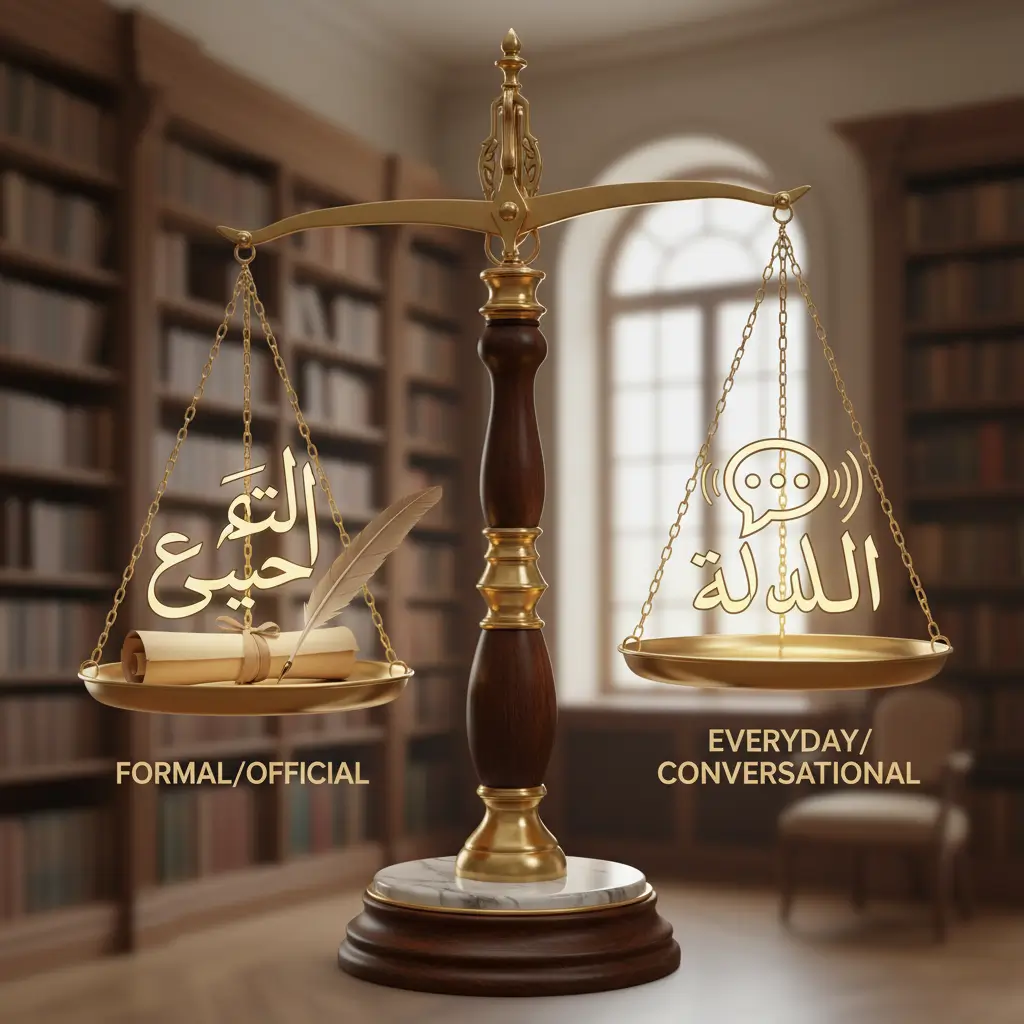
Arabic Language (Fusha) — also called Modern Standard Arabic (MSA) — is the formal, standardized Arabic used for writing, media, education, and official communication across all 22 Arab countries. It’s the Arabic of Al Jazeera, academic research, literature, and professional correspondence. It’s not a dialect. And it’s not the Arabic people casually speak at home.
If you’re trying to figure out whether Fusha is what you need — and how to actually learn it online — this guide covers everything. Honestly, without shortcuts.
What Exactly Is Arabic Language (Fusha)?

Fusha. Al-Fusha (الفصحى). Modern Standard Arabic. MSA. Different names, same language.
Arabic Language (Fusha) is the standardized, formal variety of Arabic used across the Arab world for:
- Written communication — books, newspapers, websites, official documents
- Formal speech — news broadcasts, lectures, speeches, presentations
- Education — school textbooks, university courses, academic papers
- Media — Al Jazeera, BBC Arabic, newspapers, serious journalism
- Literature — contemporary novels, poetry, essays
- Professional contexts — business correspondence, international relations
- Pan-Arab communication — when Arabs from different countries need mutual intelligibility
The key characteristic: Fusha is standardized and consistent across all Arab countries. A Lebanese reads the same Fusha as an Egyptian, Saudi, or Moroccan — even though their spoken dialects are dramatically different.
The Three “Arabics”: Understanding the Distinctions
A lot of learners get confused here. There are actually three distinct forms of Arabic — and they serve completely different purposes.
Fusha (Modern Standard Arabic) — Writing, formal speech, media, education. Used by all educated Arabs. Learn it for reading, writing, formal communication, and pan-Arab contexts.
Classical Arabic (Quranic Arabic) — The Quran, classical Islamic texts, classical poetry. Used by religious scholars and classical literature students. Learn it for Quran understanding, Islamic studies, and classical texts.
Colloquial Arabic (Dialects / Ammiya / Darija) — Daily conversation, informal settings. Used by everyone in daily life. Learn it for living in a specific Arab country, casual conversations, and informal contexts.
Key insight that changes everything: Fusha evolved FROM Classical Arabic, adapting it for modern needs while preserving grammatical structure. A Fusha learner approaching the Quran already understands most of the grammar and a significant portion of the vocabulary.
Fusha vs Dialects: The Honest 2026 Comparison
This is the question every Arabic learner eventually faces: should I learn Fusha or a dialect first?
The answer depends entirely on your goals. But here’s the comparison you actually need — without the marketing spin.
Where Fusha Wins Decisively
Reading and writing. 98% of Arabic writing is Fusha. Books, newspapers, websites, academic texts, business documents — all written in Fusha. Want to read Arabic in any substantial way? Fusha is not optional. Dialects are overwhelmingly oral. While dialects appear in informal digital communication, there’s no standardized written form for most of them.
Pan-Arab access. An Egyptian dialect speaker struggles in Morocco. A Lebanese dialect speaker struggles in Algeria. But Fusha? Understood by educated speakers across all 22 Arab countries. One variety of Arabic — 22 countries, 400+ million speakers.
Professional and academic contexts. Journalism, international relations, translation, academia, law, diplomacy — all require Fusha. No dialect substitutes for MSA in these fields. Full stop.
Media comprehension. Al Jazeera, BBC Arabic, serious journalism, documentaries — all Fusha. Pop entertainment uses dialects, but news and formal analysis require MSA.
Quranic foundation. Fusha provides 70–80% overlap with Classical/Quranic Arabic. Far more efficient than starting with dialect and then separately tackling Classical grammar.
Where Dialects Win
Conversational speed. A learner who studies Egyptian Arabic for three months will typically achieve functional conversation faster than someone spending three months on Fusha. Dialects are built for conversation. Fusha is not.
Social fluency. If you walk down a street in Cairo, Tunis, or Baghdad and try to have a conversation in Modern Standard Arabic, you’ll be understood — but you’ll sound academic and formal. Native speakers will often simplify their speech. You won’t blend in. Dialects let you sound like a real person having a real conversation.
Daily life in one specific country. If you’re moving to Egypt, spending a year in Jordan, or working daily with Lebanese colleagues — the local dialect is more practical for social situations.
The Decision Framework
Choose Fusha if: You want to read Arabic. You need Arabic for academic or professional purposes. You want one variety working across all Arab countries. Quranic understanding is a priority. You value formal, structured learning with clear progression.
Choose Dialect if: You’re moving to a specific Arab country and need survival language fast. Your primary goal is casual conversation with people from one region. You’re interested in Arab pop culture. You have specific family connections requiring that dialect.
Ideal approach (if time permits): Foundation in Fusha first, then add dialect as needed. Fusha learners acquire dialects relatively easily because of shared roots and vocabulary. Dialect-only learners struggle adding Fusha later — it requires learning an entirely different grammar system they’ve never encountered.
For a full MSA vs dialect breakdown with current course options, see the Modern Standard Arabic Online: Full 2026 Comparison.
Who Needs to Learn Arabic Language (Fusha)?
Fusha serves diverse people with very different motivations. Here’s who it’s actually for.
Complete Beginners Seeking Comprehensive Arabic
Starting from zero and want real literacy — not just basic phrases? Fusha gives you the foundation for both reading and speaking. You can add a dialect later. Starting with Fusha prevents fragmentation: learning Egyptian dialect but then needing to read anything becomes its own separate challenge.
Muslim Learners Seeking Quranic Access
While the Quran uses Classical Arabic, Fusha provides 70–80% comprehension foundation. It’s far more efficient than starting with an unfamiliar dialect and separately tackling Classical grammar. The strategic path: Fusha → Classical Arabic. Typically 18–30 months to full Quranic understanding, versus 24–36+ months starting from Classical Arabic with no Fusha base.
Professionals Requiring Arabic Literacy
Diplomats, business people, journalists, NGO workers, academics, translators — professional Arabic work requires reading reports, understanding formal speeches, writing correspondence, engaging with media. All Fusha domains. Dialect helps with local relationships but doesn’t cover the professional need.
Heritage Speakers Adding Literacy
Many Arab-heritage individuals speak a dialect at home but can’t read or write Arabic script. Fusha bridges the gap between oral family dialect and literate participation in Arab culture — enabling reading literature, understanding formal media, writing to relatives in Arabic, accessing educated discourse.
Academics and Researchers
Contemporary Arabic scholarship, historical analysis, social commentary, academic journals — primarily in Fusha. Classical Arabic is needed for medieval texts, but modern scholarly discourse is MSA.
Spiritual Seekers and Islamic Studies Students
Contemporary Islamic scholarship, explanations of Hadith, Fiqh texts, spiritual literature — overwhelmingly in Fusha. Classical Arabic is needed for the oldest sources, but most modern Islamic education is conducted in MSA. Fusha is the practical gateway.
How to Learn Fusha Arabic Online: Top Methods for 2026
Here’s the thing most “learn Arabic” guides don’t say: the method matters as much as the motivation. Choosing the wrong format wastes months.
Method 1: Live 1-on-1 Online Instruction (Best for Most Adults)
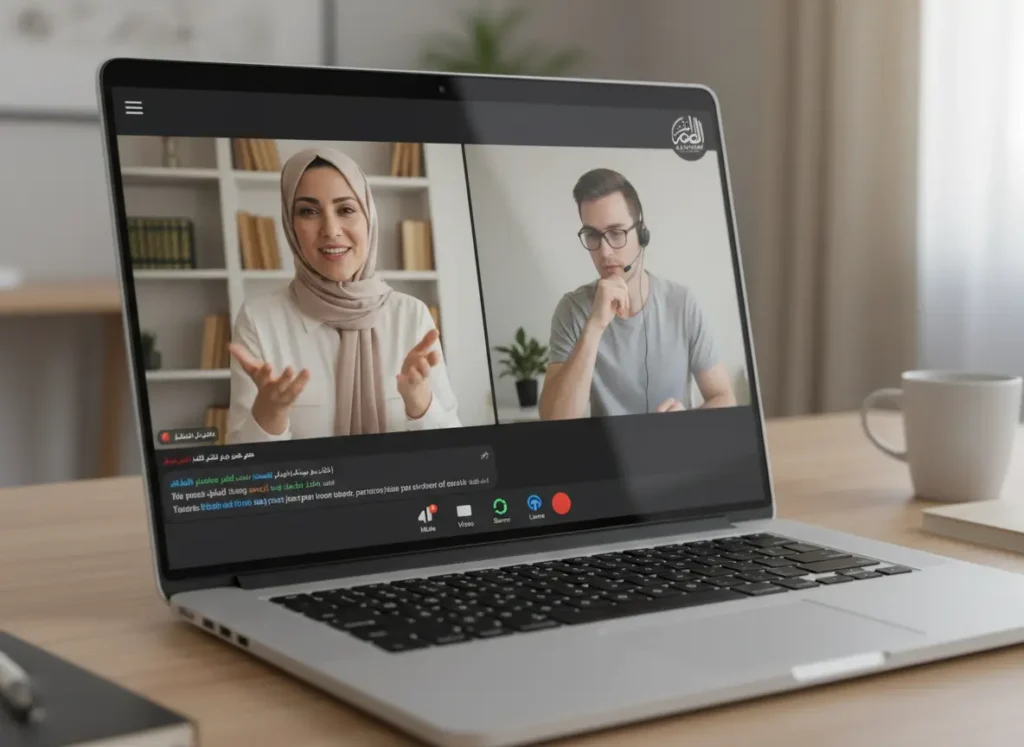
The most effective format for serious Fusha learners. You get a native teacher, a structured curriculum, real-time pronunciation correction, personalized pacing, and verified certificates at each level.
At Alphabet Arabic Academy, the MSA program is designed to take you from beginner to fluent communicator — covering all four core skills:
- Reading — newspapers, books, and online content
- Writing — from simple sentences to advanced formal texts
- Listening — media, conferences, and formal conversations
- Speaking — confident communication in formal settings
All sessions are live and 1-on-1. Every teacher is a certified native Egyptian Arabic speaker with a university degree. See pricing and packages starting from $40/month.
Method 2: Live Group Classes Online
More affordable than 1-on-1. Less personalization. Still effective if the curriculum is solid and class sizes are kept small. Look for programs with no more than 5 students per group.
Method 3: Self-Paced Online Courses
Useful for supplementing formal instruction. Not sufficient as a primary learning method for Fusha. Arabic grammar complexity and pronunciation challenges make self-teaching genuinely difficult. Self-taught learners without prior foreign language experience almost always plateau early.
Method 4: Hybrid Approach (Recommended for Busy Adults)
Formal live instruction 2–3x per week + daily self-study (30 minutes) + regular listening practice. This combination provides structure, personalization, and the consistency that builds real proficiency.
Method 5: University Programs and Intensive Immersion
The fastest route to advanced proficiency — but requires major time and financial commitment. Full-time immersion programs at institutions like AUC in Cairo estimate 22 months to professional working proficiency at 25 hours per week. Not realistic for most working adults, but powerful for students with the time.
The Method That Doesn’t Work
Apps and videos as your primary learning tool. Duolingo, Pimsleur, Memrise — these are excellent supplements for vocabulary exposure. They cannot replace live instruction. They cannot correct your pronunciation of ع, ح, or ق. They cannot adapt when you’re stuck on a grammar concept. Use them alongside a structured program, not instead of one.
Modern Standard Arabic Online: The Full Learners Comparison
Not all online MSA programs are equal. Here’s how the main options compare for learners in 2026.
Alphabet Arabic Academy — MSA Program
Best for: Adults and professionals wanting structured 1-on-1 instruction with a verified certificate.
What you get: Native Al-Azhar-trained teachers, curriculum aligned with ACTFL and CEFR standards, all four skills covered, verified certificates at each level, flexible scheduling 24/7, all materials included at no extra cost.
Pricing: Starting from $40/month. Discounts available for 3-month (10% off) and 6-month (20% off) enrollment.
Certificate: Issued by Academic Director after passing 70% assessment — oral (60%) and written (40%). Includes unique ID and QR verification code. Full certification policy here.
Self-Study Platforms (Udemy, Coursera, edX)
Best for: Supplementary learning and vocabulary exposure.
Limitations: No live pronunciation correction, no real feedback, no oral assessment, certificates of limited external credibility.
App-Based Learning (Duolingo, Memrise, Pimsleur)
Best for: Daily vocabulary reinforcement as a supplement.
Limitations: Not suitable as primary Fusha learning. No grammar depth, no writing instruction, no certified outcomes.
University Arabic Departments (Online)
Best for: Students seeking academic credit and formal degrees.
Limitations: Expensive, often rigidly scheduled, designed for traditional students rather than working adults. Quality varies significantly by institution.
Private Tutors (italki, Preply)
Best for: Learners who want personalized sessions without committing to an academy curriculum.
Limitations: Quality varies enormously. No guaranteed curriculum structure. Finding a genuinely qualified Fusha teacher (as opposed to just a native speaker) requires careful vetting.
Learn Modern Standard Arabic Quickly: Realistic Timelines for Adults
Let’s be completely honest about timelines. Anyone promising fluency in a few weeks is not being straight with you.
The US Foreign Service Institute (FSI) categorizes Arabic as Category IV — the most difficult for English speakers. Their estimate: 2,200 classroom hours to professional working proficiency. That’s roughly 88 weeks of intensive full-time study at 25 hours per week.
For most adults, here’s the realistic picture:
Study 2–3 hours per week (casual): 8–12 years to advanced proficiency. Slow but sustainable for hobbyists.
Study 5–7 hours per week (serious part-time): 4–6 years. Realistic for most working professionals.
Study 10–15 hours per week (intensive part-time): 2–3 years. Requires real commitment but achievable alongside work.
Full-time immersion (25+ hours per week): 1.5–2 years. Language school or university program format.
What You Can Actually Achieve at Each Stage
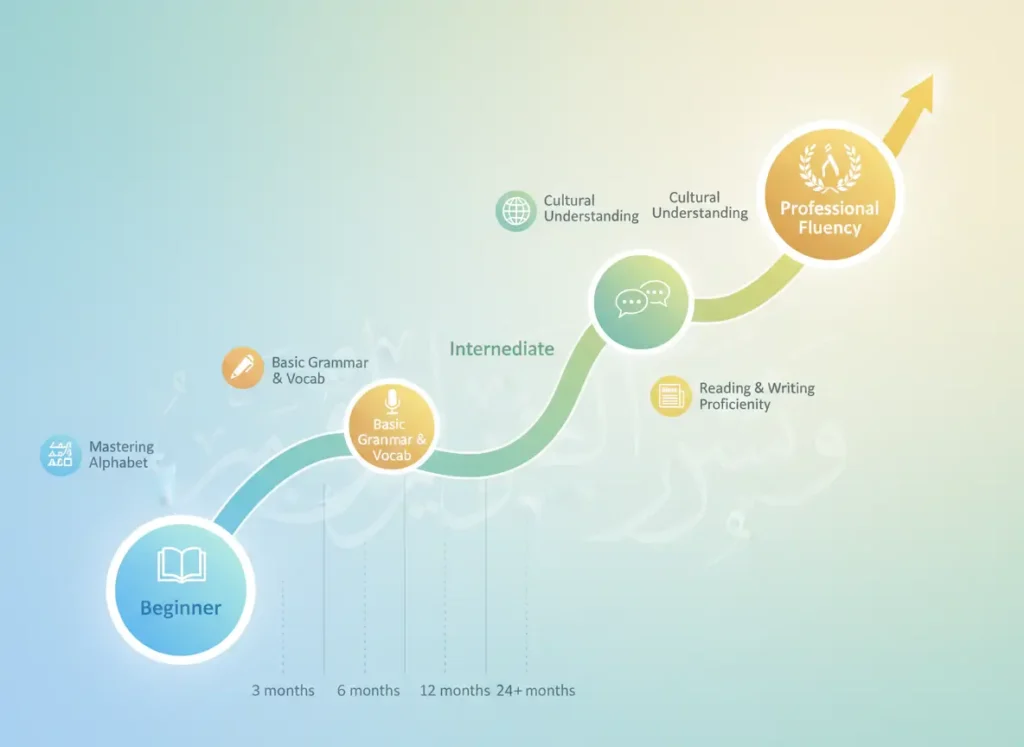
After 3 months (100–150 hours): Read Arabic alphabet fluently. Pronounce words correctly. Understand basic grammar. Read simple voweled texts. Write basic sentences. Productive vocabulary: 300–500 words.
After 6–9 months (300–500 hours): Read simplified news articles. Understand slow, clear Fusha speech. Write short paragraphs. Grasp intermediate grammar. Productive vocabulary: 1,000–1,500 words.
After 12–18 months (600–1,000 hours): Read authentic newspapers and simple novels. Understand standard news broadcasts. Write multi-paragraph essays. Productive vocabulary: 2,000–3,000 words. Functional intermediate proficiency.
After 24–36 months (1,500–2,500 hours): Read novels and academic papers. Understand lectures and debates. Write formal correspondence and research papers. Deliver presentations in Fusha. Productive vocabulary: 4,000–6,000 words. Advanced proficiency — professional competency.
The honest question isn’t “Can I learn this fast?” It’s “Am I willing to invest what advanced Arabic actually requires?” For most learners, the answer — once they understand what they’re getting in return — is yes.
Not sure where you stand right now? Take the free Arabic level test before committing to any program.
The Four Pillars of Fusha Proficiency

Strong Fusha learning develops all four skills simultaneously. Programs that focus only on grammar and reading produce learners who can’t use the language. Here’s what balanced development looks like.
Reading (القراءة)
Progression: From alphabet → simple texts → news articles → novels → academic papers.
Short-voweled texts (with harakat) first for 6–12 months. Then gradually transitioning to unvoweled authentic materials as vocabulary grows. The common mistake: jumping to unvoweled texts before building a vocabulary base of at least 1,500–2,000 words.
Writing (الكتابة)
Progression: From Arabic script → basic sentences → paragraphs → essays → formal documents → research papers.
Daily writing practice matters more than most learners realize. Even 5 sentences in a journal every day compounds into thousands of sentences of written output over a year.
Listening (الاستماع)
Progression: From beginner audio → structured dialogues → slow news → Al Jazeera → university lectures → academic debates.
This skill is the most neglected. Learners who focus exclusively on reading and grammar are always surprised when they can’t understand spoken Fusha — even after months of study. Listening and reading are distinct skills. Train both from day one.
Speaking (التحدث)
Important reality check: Fusha speaking is primarily formal contexts. Unlike dialects (used for daily conversation), Fusha speaking typically means delivering presentations, formal meetings and speeches, academic discussions, media interviews, and public speaking. Casual conversation uses dialect, even among educated Arabs. A Fusha speaker is not expected to chat casually in MSA — that would sound like speaking in Shakespearean English at dinner.
What to Look For in a Fusha Arabic Course
Not all courses are legitimate. These eight criteria separate real programs from well-marketed ones.
1. Native Arab instructors with formal teaching credentials
Not just “native speakers.” Teachers with degrees in Arabic language education and formal training in teaching Arabic as a foreign language. At Alphabet Arabic Academy, every teacher is a certified native Egyptian speaker — graduates of Al-Azhar University or Cairo’s leading Arabic institutions — trained specifically for non-native learners.
2. Structured progressive curriculum
Clear curriculum showing logical progression from beginner to advanced. Aligned with recognized frameworks (ACTFL or CEFR). No vague “learn at your own pace” without actual structure.
3. Balance of all four skills
Reading, writing, listening, AND speaking. Programs focusing exclusively on grammar and reading produce imbalanced learners who can’t use the language functionally.
4. Authentic materials integration
Real news articles, media clips, and literature — adapted progressively for each level. Not just textbook dialogues and contrived materials throughout.
5. Qualified pedagogical approach
Knowing how to speak Arabic and knowing how to teach it are different things. The best instructors have formal training in teaching Arabic as a foreign language — not just lived experience as native speakers.
6. Flexibility for busy adults
Online access, flexible scheduling options, and the ability to reschedule without penalty. Consistency matters more than intensity — a program that doesn’t fit your life will be abandoned.
7. Regular progress tracking and assessment
Regular quizzes, clear feedback on assignments, progress reports, and objective proficiency level tracking. If a program can’t tell you your current level, that’s a problem.
8. Verifiable certificates
A real certificate is not a PDF you generate yourself after finishing a quiz. At Alphabet Arabic Academy, each certificate includes a unique ID (format: AAA-YYYY-XXXXX), a QR verification code, and the signature of the Academic Director — an Al-Azhar-trained educator with 20+ years of experience. Pass mark: 70%, combining oral (60%) and written (40%) assessment.
For learners specifically seeking a credential, the Modern Standard Arabic Course with Certificate Online explains exactly how the certification pathway works.
Study Strategies That Actually Work for Fusha

Knowing what to study is half the battle. Knowing how to study is the other half.
Spaced Repetition for Vocabulary
First 1,000 words: essential high-frequency vocabulary. Next 1,000–3,000: expanding to functional literacy. Use flashcard apps with spaced repetition (Anki is the standard). Review new vocabulary at intervals of 1 day, 3 days, 1 week, 2 weeks, 1 month.
Functional Arabic literacy requires approximately 3,000–4,000 words. Professional competency: 6,000–8,000 words. Focus your energy on high-frequency vocabulary first.
Extensive Daily Reading
Read every day. Even 15 minutes. Start with graded readers (simplified texts at your level), progress to authentic materials as vocabulary grows. Track pages read — aim for at least 1,000 pages per year once you reach intermediate level. Read for meaning, not word-by-word translation.
Active Listening Practice
30+ minutes of Fusha audio daily. Begin with learner-level content (ArabicPod101, structured dialogues). Progress to Al Jazeera news, TED talks in Arabic, university lectures. Use transcripts initially, then wean off them.
Consistent Output (Writing and Speaking)
Daily journal in Arabic — even 5 sentences. Weekly essay on a topic of interest. Shadowing technique for speaking: repeat after native audio until you match the rhythm and pronunciation. Record yourself and compare to native models. Tutoring sessions with dedicated speaking focus.
Consistency Over Intensity
30–60 minutes daily of focused practice beats 5 hours once a week. Every time. Distributed practice produces far better long-term retention than massed sessions. Build Arabic into a fixed daily routine — same time, same place. Don’t skip more than one day.
Common Mistakes That Keep Fusha Learners Stuck
These aren’t minor issues. They’re the reasons most self-directed Arabic learners plateau and quit.
Mistake 1: Starting with unvoweled texts too soon.
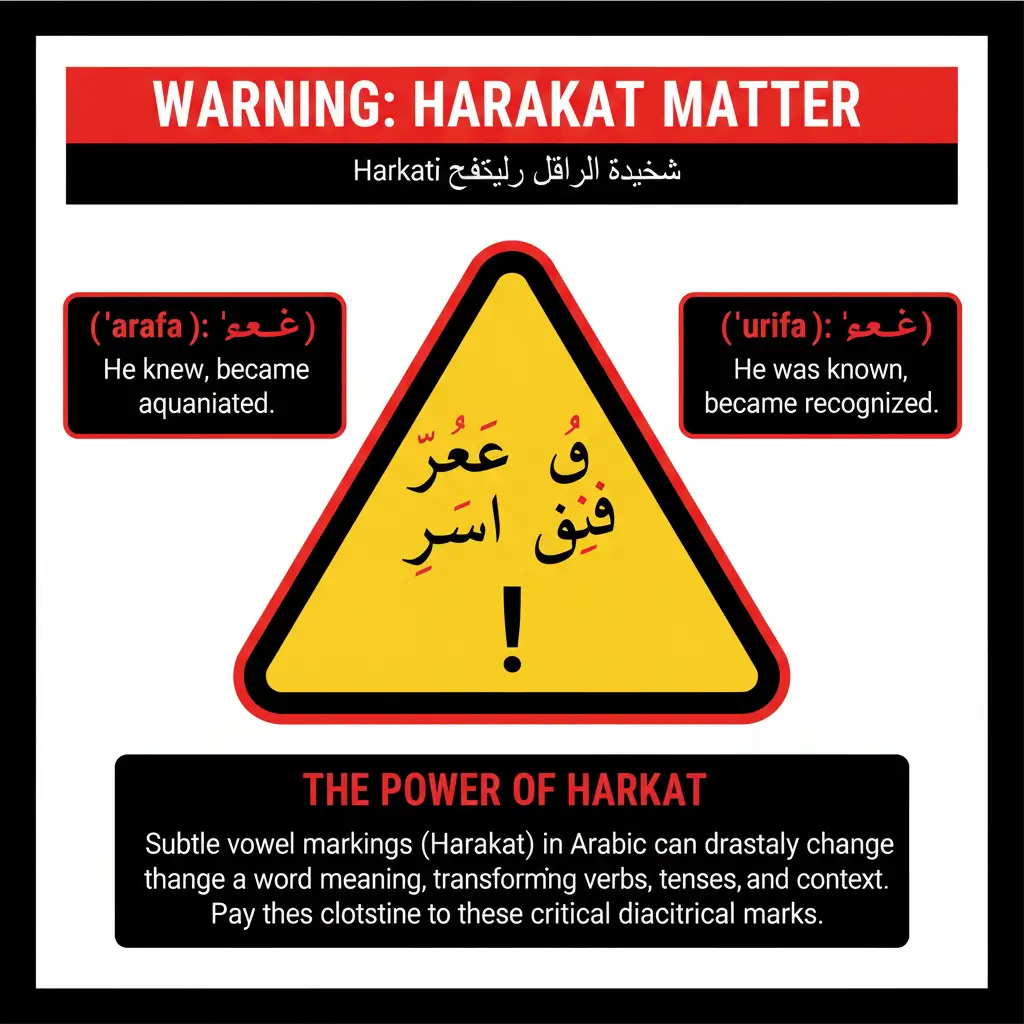
Arabic short vowels (harakat) are typically omitted in adult texts. Reading unvoweled text requires vocabulary knowledge to infer pronunciation. Beginners lack this vocabulary, get frustrated, quit. Solution: spend your first 6–12 months exclusively with voweled texts. Build a 1,500–2,000 word vocabulary base before transitioning to unvoweled materials.
Mistake 2: Neglecting listening practice.
Excellent readers can still struggle comprehending spoken Fusha if they’ve never practiced listening. Reading and listening are distinct skills. From day one, train your ear to Arabic sounds and prosody — even before you understand individual words.
Mistake 3: Perfectionism paralysis.
Language learning requires imperfect production and gradual refinement. Refusing to progress until the current level is “perfect” prevents the necessary practice. Aim for 80% accuracy and keep moving. Mistakes are data, not failures.
Mistake 4: No clear goals.
“I want to learn Arabic” is not a goal. “Read one Arabic news article weekly within 6 months” is a goal. “Write a 300-word essay in Arabic by month 12” is a goal. Concrete targets create measurable milestones. Vague goals create drift.
Mistake 5: Isolating language from culture.
Arabic embeds culture in its vocabulary, idioms, and rhetorical conventions. Without cultural context, words lack depth and motivation suffers. Follow Arabic social media accounts. Read about Arab history. Watch Arabic films — even if you don’t understand fully at first. Language becomes a meaningful tool, not an abstract code.
Mistake 6: Comparing your timeline to faster learners.
Many “fluency in 6 months” claims refer to basic dialect conversation — not comprehensive Fusha proficiency. Arabic takes years of consistent study. Compare yourself to your past self. That’s the only useful comparison.
Who Is This For?
This is for you if:
- You want to read Arabic — books, news, academic texts, websites
- You need Arabic for a professional reason: journalism, diplomacy, academia, law, translation, NGO work
- You’re a Muslim who wants to understand the Quran directly, not just through translation
- You’re a heritage speaker who can converse in dialect but can’t read or write Arabic script
- You’re a researcher who needs to engage with Arabic-language academic sources
- You want a standardized formal Arabic that works across all 22 Arab countries
This is NOT for you if:
- Your only goal is casual conversation in one specific country (a dialect course is more efficient)
- You’re expecting quick results without consistent effort
- You’re not willing to invest at least 5–7 hours per week of focused study
Let me tell you about Ali.
Ali came to us speaking zero Arabic. Not a single word. He lived in America his whole life, and he was convinced he couldn’t learn a new language. His biggest problem? He never had time. Work, family, life — something always came first.
Teaching Ali was hard. I mean, really hard. He struggled to study even one lesson a week. Every session, we had to remind him of things he learned before. We had to fight for every letter, every word.
But Ali never quit.
He just kept showing up. Every time. Even when he was tired. Even when he had a dozen excuses ready.
Then, slowly, things started clicking.
Today, Ali reads Arabic on his own. He writes on his own. His vocabulary is huge.
But here’s what makes me most proud.
Last month, he met two Egyptians at the mall near his house. You know what happened? He started speaking Arabic with them. Right there. In the middle of the mall. They became friends.
When Ali told me about it, I could hear the joy in his voice.
He’s not a professional yet. But he’s on his way. And he’s living proof that you don’t need hours a day. You don’t need to be in an Arab country. You just need the right method, a teacher who cares, and the stubbornness to keep showing up — even when you think you have no time.
Ali went from zero to conversations in the mall.
You can be like Ali. Don’t hesitate.
Real Success Stories: What Learners Achieve
3-Month Win: Sarah’s Reading Breakthrough
Background: Marketing professional, zero Arabic. Goal: Read Arabic social media for market research. Intensive Fusha program at 15 hours per week. Result at 3 months: reading Arabic tweets and Facebook posts, understanding 60% of news headlines, basic business vocabulary mastered. The key: high intensity + specific measurable goal from day one.
6-Month Win: Ahmed’s Heritage Literacy
Background: Egyptian-American who spoke Egyptian dialect but couldn’t read a single Arabic word. Goal: Read Arabic to connect with heritage. Fusha literacy focus at 8 hours per week. Result at 6 months: reading Arabic novels fluently, writing emails to Egyptian relatives in Arabic, understanding formal Arabic media. The key: existing dialect foundation accelerated vocabulary — but formal literacy required dedicated Fusha study.
12-Month Win: Fatima’s Quranic Understanding
Background: British Muslim, wanted to understand the Quran without translation. Combined Fusha and Classical Arabic elements at 10 hours per week. Result at 12 months: understanding 75% of the Quran directly, reading Tafsir in Arabic, experiencing a transformed relationship with salah and Quranic recitation. The key: clear spiritual motivation paired with structured approach.
18-Month Win: Tom’s Professional Arabic
Background: Foreign service officer. Goal: Work in Arabic professionally. Full Fusha program at 12 hours per week. Result at 18 months: reading intelligence briefings in Arabic, writing professional reports, presenting at regional conferences. The key: career necessity creating consistent daily motivation.
Pattern Recognition
Clear goal = faster progress. Consistent hours = better outcomes. Immediate application = stronger retention. Qualified instruction from day one = correct foundations that don’t need rebuilding later.
Frequently Asked Questions

Q1: Is Fusha necessary, or can I just learn a dialect?
Depends entirely on goals. Dialect suffices if you only want casual conversation in one specific country. Fusha is necessary if you want reading ability, pan-Arab communication, professional competency, Quranic access, or formal language skills. Most serious learners eventually need both — but starting with Fusha provides a better foundation because the structure transfers to dialect learning, while dialect-first learners must essentially start over for Fusha.
Q2: Can I learn Fusha without a teacher using only apps and books?
Possible but significantly harder. Arabic grammar complexity and pronunciation challenges make self-teaching extremely difficult. Most successful self-taught learners either had prior foreign language experience or exceptional self-discipline. Qualified instruction dramatically accelerates progress and prevents fossilized pronunciation errors that become permanent habits.
Q3: How much does Fusha overlap with Quranic Arabic?
70–80% overlap. Fusha provides an excellent foundation. Key differences: the Quran uses some archaic vocabulary and grammatical constructions not in modern MSA. But a Fusha learner approaching the Quran already understands most grammatical structure and much vocabulary — requiring supplementary Classical Arabic study for the remaining archaic elements, not learning from scratch.
Q4: If I learn Fusha, will Arabs understand me when I speak?
Yes — in formal contexts. Arabs use Fusha for formal speech: presentations, lectures, media, official meetings. In casual conversation they use dialect. Speaking Fusha casually sounds formal and bookish (like delivering a BBC broadcast at dinner). Solution: learn Fusha for formal contexts and add the relevant dialect if social fluency is also a goal.
Q5: Should I learn Arabic script or use transliteration?
Learn Arabic script from day one. No exceptions. Transliteration is a crutch that prevents real literacy and creates pronunciation fossilization — because Arabic sounds map very poorly to English spelling. Script learning takes 2–3 months of focused effort. Transliteration dependence creates years of remedial work.
Q6: Is online Fusha learning as effective as in-person?
Research shows no significant difference in outcomes when online instruction is high-quality: live interaction, qualified teachers, structured curriculum. The key is instruction quality, not format. Passive video content doesn’t compare to live 1-on-1 sessions. But live online instruction with a native teacher is equally effective as in-person.
Q7: What vocabulary level do I need for different goals?
Functional literacy: 3,000–4,000 words. Reading newspapers comfortably: ~5,000 words. Professional competency: 6,000–8,000 words. Academic texts: 8,000–12,000 words. Native-like range: 20,000+ words (not necessary for most learners). Your vocabulary building plan should reflect which target you’re actually aiming for.
Conclusion
Learning Arabic Language (Fusha) is not quick. It’s not easy. It will take 2–4 years of consistent study to reach advanced proficiency — and that’s with qualified instruction and serious weekly commitment.
But consider what those years build.
Access to the formal discourse of 400+ million people — their news, literature, academic work, professional communication. Career advantages that persist for decades. Quranic comprehension for Muslim learners. 1,400 years of intellectual and cultural heritage. Cognitive benefits from mastering one of the world’s most complex language systems.
The question isn’t “Is 2–4 years worth it?” The question is: “What will I regret more in 5 years — having studied Arabic, or not having started?”
Every fluent Arabic reader started unable to recognize a single letter. What separates them from those who stayed stuck: they started, found qualified instruction, practiced consistently, and persisted through the inevitable plateaus.
Here’s how to take the next step:
👉 Take the free Arabic level test — get your honest starting point before committing to anything.
👉 View the MSA course and pricing — starting from $40/month, with a free first lesson and 7-day money-back guarantee.
👉 Meet the teachers — see exactly who will be teaching you before you book.